
As the presenter of Channel 4’s Grand Designs, Kevin McCloud has given viewers a glimpse of some of the UK’s most ambitious self-building projects. Grand Designs Live, also presented by Kevin, is based on the hugely successful TV show and offers visitors access to expert advice, product launches and specialist exhibitors. We caught up with Kevin during the first of this year’s Grand Designs Live events and put some questions to him about the issues affecting the sector.
What are the aims/objectives of Grand Designs Live? How has the event evolved over the years?
I'm not sure that we’ve ever discussed this in depth in our meetings about the exhibition! Instead we almost feel our way forwards, keeping the good bits (like the free Ask the Expert Advice Centre, now with added Graven Hill self-build juicy bits) and building the new with dynamic ideas that reflect the here and now and what we sense people would like. That sounds slightly wishy-washy but it is backed up with a heap of research.
From my point of view it’s about delivering an experience and involvement that does not imitate the telly series, but complements it – almost as though you're behind the scenes of self-build and able to explore the supply chains, meet architects and experts, and share in the like-mindedness of 100,000 people all of whom love good design, craftsmanship and architecture.
We’ve also always wanted to offer our visitors a grand day out, with food, a constant rotating choice of talks and live interviews and lots to see and do.
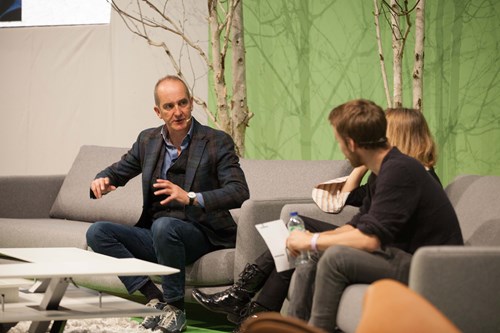
Image credit: Bircan Tulga
You are best known for Grand Designs. Do you think that the programme has changed the way that many people think about building new homes, or the way that they build?
I’d like to think so. But you've got to remember that television is entertainment and – especially in the case of Grand Designs – storytelling. If we have any effect, that’s a bonus. The hardest thing television can achieve is to get people to think, let alone act. So, it’s important that the series reaches out to as many people as possible, doesn't preach to the converted, and offers glimpses of what might be possible for us all. Telly at its best is a highly crafted form of show-and-tell.
What action would you like to see to encourage more people to self-build?
It’s happening. The Street, my series on Channel 4, shows how accessible and affordable self-build can be. It took five years to make and started with a trip to Almere, self-build capital of The Netherlands, in 2010. At that time only one or two mortgage companies, like The Ecology were offering self-build mortgages; now there are dozens of providers (often run by people who’ve self-built themselves) in the marketplace, from the Halifax to Melton Mowbray Building Society. Having said that, my one hope for The Street is that it stimulates demand. It’s set at Graven Hill, Cherwell District Council’s site for 1900 self-build and custom-build homes at Bicester. The rest of the site is now under construction and demand for the ready-made plots is strong. What we need now is for other local authorities to follow Cherwell’s lead and provide larger, inspirational sites for self-build on a similar scale. When you offer self-builders a site with four or five self-build plots on it, it’s difficult to provide the fast-track planning, oven-ready foundations and support that home builders need. Doing it at scale offers the self-builders greater security, support and inspiration.
I’d also like to see the statutory obligations for local authorities, set out in the Right to Build Act, enforced properly. Local authorities are mandated to keep registers of sites and registers of interested self-builders. Research shows that the lists nowhere near match the levels of interest in the market which suggests that they should be doing a lot more to promote sites and promote their own support of self-build. At the very least the common practice of charging people to access the lists is scurrilous and should be stopped. It’s the obvious resort of a lazy local authority.
You have spoken out in the past about the quality of homes built by large scale developers. In your opinion what needs to be done to improve quality?
We design buildings with great care and attention to detail in the UK but unless you have the construction skills in place, you can build nothing of quality. So, education and training is what’s needed in abundance, through schools, apprenticeships, day release and Continuing Professional Development (CPD) that can support tradesmen as they grow their businesses. Yes, there’s training and CPD out there but we need a great deal more. I’d like to see constructors pay a per project fee to a central training fund run by the industry for this – in the same way the medieval guilds financed training and quality standards. Some suggest that off-site manufacturing holds the key to ensuring greater reliability and quality. I believe it’s no Holy Grail and simply offers some greater efficiencies.
What action would you like to see from the Government to support SME construction firms to get building?
I'd like to see the Government making good its pledge to support SMEs right across a spectrum of areas. In residential construction we’re already seeing finance being made more widely available for small construction firms through Homes England and that’s excellent. The Homes England regional panels also already provide opportunities for SMEs to fast-track bid on government-owned land. My own company, HAB, is on two of the regional panels but we’re one of very few smaller businesses and frankly we have to compete with the larger players and we lose out. In a perfect world we’d see a two-tier structure, where Homes England set aside their smaller projects, say of up to 100 homes, for SMEs only, or a world where SMEs get first bite at the list. And I’d like to see a situation where the heavily bureaucratic application process for SMEs is at the very least matched by a form of Government insurance to support those businesses.
What do you think about the biodiversity targets for developers announced in the Spring Statement? Do you think they are a force for good or will they just increase costs and delays for SME firms?
Enhancing biodiversity, building green and delivering extraordinary placemaking – not just house building – should be everyday objectives of anybody in construction. No excuses. It’s what HAB is dedicated to doing. Yes, it costs more in cash but the research we’ve commissioned shows that it delivers wider cash benefits to the social infrastructure of a place (in terms of a relief in the burden to the health, transport, mental welfare and educational systems) as well as delivering against triple bottom line objectives. Banks increasingly want to see these targets addressed when lending.
What do you think needs to be done to tackle the skills shortage?
A lot. In the 1944 Education Act, R.A.B. Butler proposed three tiers of schools: Grammars. Secondary Moderns and Technical Schools. The latter were never built at scale and even the eventual Comprehensive system failed to deliver proper dedicated technical training for Britain's pupils. What’s really dreadful about this is that the education system has, for 75 years, produced generations of people who don’t even value skills and craftsmanship because it’s never been part of their educational world and never engrained into society as a result of this educational failure.
I’m mindful that in Germany there is still a culture of apprenticeships for so many trades, whereas here all I hear from experienced hands in construction is how the skills are evaporating from the industry. I’m a lucky product of the state education system, having gone to a grammar school that turned comp. So, you won’t be surprised to learn that I’m still in favour of technical schools and technical education between the ages of 12 and 18. Education, education, education.