Disclosure: FMB Home Picks is committed to delivering independent advice and reviews on home products and services. When you purchase through links on our site, we may earn an affiliate commission.Learn moreContact us.

Solar panel grants and funding can help households access renewable energy solutions, potentially reducing their energy bills by over £1,000 a year.
With the recent launch of the UK government’s Warm Homes Plan, which is set to be the largest energy efficiency initiative in British history, there are more solar panel funding options available than ever.
These range from group buying schemes such as Solar Together to solar panel grants such as ECO4, through which eligible households can claim free solar panels. ECO4 is set to expire at the end of the month, on the 31st of March, so find out if you’re eligible below and apply before it’s too late!
Our experts have conducted hundreds of hours of research and interviewed top grant providers to give you detailed insights into solar panel grants in the UK, including who qualifies for each scheme, how to apply, and how much solar panel funding you could receive. We also surveyed over 2,000 solar system owners in the UK* to find out how they financed their solar panel installations, providing you with real-world perspectives to guide your own solar journey.

Request solar quotes by answering a few simple questions

Get free, no obligation solar quotes from up to 5 installers near you

Compare quotes to get the best price on your installation
Get a Quote on Your Solar Installation in 60 Seconds
The average home can save more than £1,000 every year with solar panels!
These are the solar panel grants and incentives available in the UK to reduce the cost of solar panels and encourage the adoption of renewable energy.
| Grant / Funding scheme | Eligibility | How much could you get? | Provided by | Run time | EPC rating required |
|---|---|---|---|---|---|
| ENDING SOON – Energy Company Obligation 4 (ECO4) and LA Flex | Low income households in receipt of various benefits such as Universal Credit | Up to 100% of the cost of solar panel installation | UK government | April 2022 to March 2026 | E–G |
| Solar Together | Open to all | Save 30-35% on the average cost of a solar system | Participating local authorities | Closing dates vary depending on local authorities | Not applicable |
| Warm Homes: Local Grant | Low-income tenants or homeowners, recipients of means-tested benefits | Up to £30,000 towards home energy improvements including solar panel installations | UK government | April 2025 – April 2029 | D–G |
| Warm Homes Fund | Homeowners. regardless of income | Low and 0 interest loans to cover the cost of solar panels and batteries | UK government | TBC | Not applicable |
| Warm Homes Nest Scheme (Wales) | Recipients of means-tested benefits or low-income households | Up to 100% of the cost of solar panel installation | Welsh government | Ongoing | E or less, or D or less if you or a household member has an eligible health condition |
| Home Energy Grant and Loan Scheme (Scotland) | Self-builders or homeowners who meet the conditions | Loans of up to £5,000 | Scottish government | Closed for solar panel applications but open for solar thermal panels | E–G, or D–G if you have an eligible health condition |
| Smart Export Guarantee (SEG) | Open owners of solar systems up to 5MW | 20 to 40 pence per kWh from energy suppliers | Energy suppliers (as of February 2025, there are 12 Mandatory SEG Licencees in the UK) | Ongoing | Not applicable |
| 0% VAT on solar panel installations in residential properties | Open to all | Save around £1,900 on a 4.5kW system | UK government | April 1st 2022 to April 1st 2027 | Not applicable |
Depending on your living situation and your household income, you could receive free solar panels under the ECO4 scheme, the Warm Homes Nest Scheme and the Warm Homes Plan.
A grant is a form of financial support from the government or institutions that typically doesn’t need to be repaid. It can cover all or part of solar installation costs, provided you meet the eligibility criteria. A scheme is a structured programme with specific goals such as increasing solar adoption. It could take the form of a grant or loans, tax incentives, or rebates.
While eligibility criteria are dependent on the grant or scheme you’re applying to, here are some of the most common ones:
Solar grants usually only cover specific solar energy system components such as solar panels, inverters and installation costs. Battery storage or advanced monitoring systems are typically excluded.
Get solar panel quotes in your area
Still confused? Click your region below and fill out our quick form to talk to a reputable installer who can walk you through your options.
The UK Government’s Energy Company Obligation (ECO) scheme focuses on improving the country’s most energy-poor homes, particularly low-income and vulnerable households. ECO4 is the fourth “wave” of this scheme, and it is scheduled to end on the 31st of March 2026, so we recommend getting your application in soon if you would like to benefit.
The grant scheme is managed by Ofgem, the energy regulator, which requires bigger energy suppliers to supply energy-efficiency measures to UK homes. The ECO4 grant covers solar panels and other energy-efficient improvements such as heating systems, insulation and double glazing.
The Local Authority Flexible Eligibility (LA Flex) is an extension of the ECO4 grant. It enables local authorities to fund low-income and vulnerable households who require energy efficiency improvements but don’t receive income-related benefits.
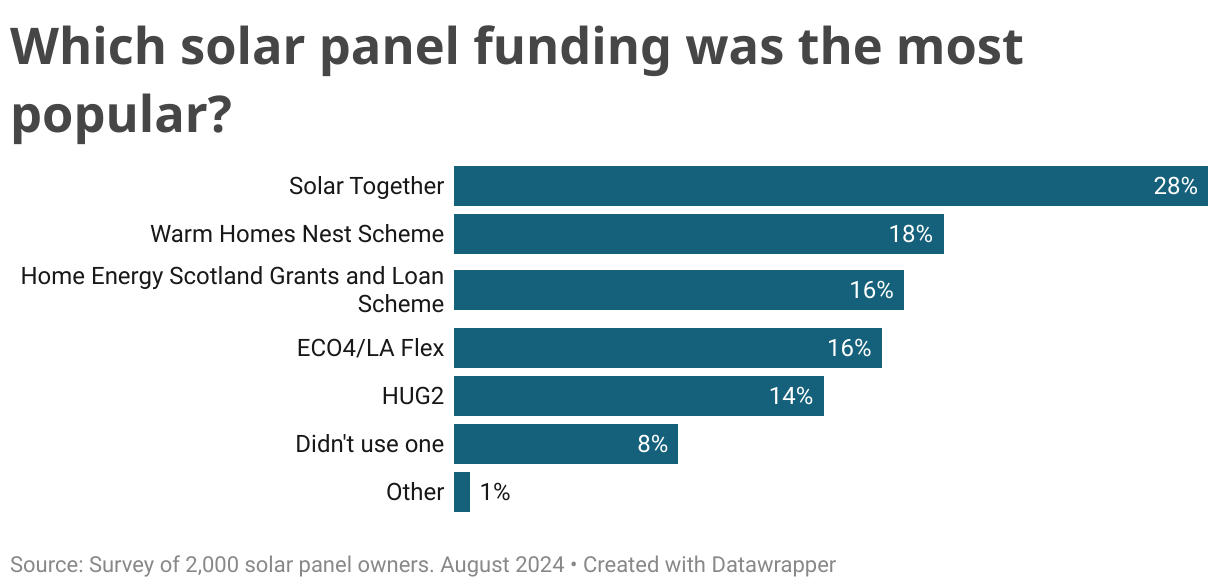
As of the end of June 2025, 10 per cent of ECO4’s 875,900 installed ‘measures’ were micro-generation measures, which include solar panels. 16 per cent of respondents to our survey* reported receiving ECO4 or LA Flex grants for their solar panel installation.
Eligible households could receive free solar panels under ECO4, though the amount awarded depends on specific circumstances. In some cases, the grant has covered the cost of multiple energy upgrades costing over £80,000, according to Kevin Henney, Director at ECO4 Hub. This could cover the cost of a property receiving a new heating system, full insulation and solar panels, for example.
The ECO4 grant is available in England, Scotland and Wales. It is currently unavailable in Northern Ireland.
In order to be eligible for an ECO4 grant, your household’s annual income must be under £31,000.
You also should be in receipt of one of the following benefits:
If the only benefit you are claiming is Child Benefit, there is an upper income threshold based on how many children you have and whether you’re a single- or 2-parent household. You will need to earn under this amount to qualify.
For single-parent households:
For 2-parent households:
If you receive benefits from the Department for Work and Pensions – regardless of whether you receive Universal Credit or not – you may be eligible for ECO4. This also applies if you receive disability benefits, such as the Disability Living Allowance or Personal Independence Payments.
Although the ECO4 grant focuses on owner-occupied homes, it can also help those in energy-inefficient social housing and privately rented properties, provided the property owner gives permission to install solar panels.
You won’t be eligible for the ECO4 if your property has an EPC rating of D or above. Under this grant, it is also required that any improvements carried out on a home rated F or lower should raise them to an EPC rating of at least D.
Local authorities use LA Flex to determine your household’s eligibility for energy-efficiency improvements. Their assessment is usually based on the assumption that you live in a property that needs energy-efficiency upgrades and one of the following statements applies.
To be eligible for LA Flex, private tenants will need their landlord’s permission.
If approved, the energy company (or grant administrator) will pay the installers directly. If the ECO4 grant does not cover the full cost of the solar panel installation, you will have to pay the remaining balance to the installer directly, or through a financing plan.
The ECO4 grant is scheduled to run until the end of March 2026; in January 2026, the UK government has announced it will not be extending the scheme as the focus is currently on transitioning into new programmes such as the Warm Homes Plan.
When installing energy-efficient home improvements through the ECO4 grant, you have several steps to complete. From application to installation, the process can take as little as two weeks.
Eligibility assessment:
Energy assessment:
Approval and planning:
Installation:
Post-installation:
You can apply to ECO4 directly through your energy supplier, including:
A surveyor will then evaluate your property and determine whether your home is suitable for solar panels.

Identification documents
Proof of income or benefits
Energy bills
Proof of ownership or tenancy
Property information
Solar Together is a group buying scheme for solar panels and batteries which operates in various UK regions. The scheme aims to make solar power more affordable and accessible for homeowners and small businesses within the UK.
It’s an increasingly popular way of funding solar panel installations: 28 per cent of respondents to our survey* chose to install their solar panels through Solar Together.
The scheme is available to homeowners and tenants with their landlord’s permission living in participating council areas. After interested parties register, solar panel providers then bid for the opportunity to install a group’s solar panels. This auction format results in a competitive installation price, which reduces the costs compared to an individual household’s quote.
Solar Together covers solar panel installations. Unlike a grant, this scheme essentially offers a bulk discount on a group’s solar panels; which makes the overall costs lower than an individual installation.
The savings you can make vary depending on the local authority, the number of households in the group and the installers’ offers. However, through this scheme, you can expect to pay between 30 and 40 per cent less than the average cost of solar panels.
Solar Together isn’t a UK-wide scheme. To find out whether it’s available in your area, check with your local authority. The organisation is currently working on expanding the scheme to more regions.
Solar Together offers competitively-priced installations from vetted solar panel installers. The application process is simple and streamlined.
Register your interest via the Solar Together website.

“Group-buying means that everyone gets a better deal. Through our scheme, participants secure average savings of 40 per cent off the typical market price [of solar panels], depending on the installation size. Registering for a Solar Together scheme takes just five minutes, and our help desk is here to support people every step of the way.
For regions with existing annual Solar Together schemes in place, we are continuing to grow the schemes and are increasing engagement in these areas. We are also launching new schemes in communities up and down the country, most recently in West Yorkshire.”
The Warm Homes: Local Grant was launched in April 2025 as part of the Labour government’s Warm Homes Plan. It aims to tackle fuel poverty, cut households’ carbon emissions and promote renewable energy adoption in lower income households.
Eligible households could receive up to £15,000 each to cover energy-efficiency improvements such as solar panel installations. They could also receive a separate £15,000 grant to install a low-carbon heating solution such as heat pumps.
This grant is available to households across England.
Eligibility requirements for the Warm Homes Plan include:
Tenants are eligible for this grant provided they have their landlord’s permission.
You can check your eligibility with the government’s free eligibility checker. It’s also worth noting that local authorities are dispensing these grants and can be flexible according to their communities’ needs, so it’s worth applying even if you don’t meet every single criteria.
Through the Warm Homes Plan, installers and contractors are paid directly by your local authority.
If you own the home you live in, you can apply directly through the Government’s eligibility checker. If you meet the criteria, you’ll be asked for your email address or phone number and your application will be sent to your local authority.
If you are a renter, you must apply to your local authority directly.
In January 2026, the UK government launched its Warm Homes Plan. The plan will benefit from up to £15 billion pounds in funding to upgrade up to 5 million homes by 2030, which would make it the largest energy efficiency scheme in British history.
On top of the Local Grant detailed above, the Warm Homes Plan will also include a Warm Homes Fund, through which homeowners regardless of income will be able to apply for low and 0 interest loans to install solar panels, solar batteries, heat pumps, home insulation and more.
The government hasn’t yet announced when these loans will be available. More details are due to be published later in 2026 and will be laid out here as soon as possible.
The Welsh Government’s Warm Homes Nest Scheme provides free energy-efficient home improvements, including solar panels, to eligible households, as well as energy-saving advice. The scheme is open to low-income families and those living in deprived communities throughout Wales.
Eligible households could receive free solar panels through the Welsh Government Warm Homes Nest Scheme.
This grant is available to eligible households throughout Wales.
You could be eligible for energy-efficiency improvements including free solar panels if you meet all 3 of the conditions below.
The installer usually receives the grant directly from Nest.
Contact Nest on 0808 808 2244.
Lines are open Monday to Friday, 9.00am to 6.00pm.
Along with your application, you’ll need to include:

Lorraine from Cardiff funded her solar panel system thanks to the Nest scheme. Her home had an EPC rating of F, she is on Universal Credit and her husband, who suffers from heart problems, receives Personal Independence Payments.
“I applied thinking I’d get turned down as it seemed too good to be true, but after two weeks, I heard back. I had to answer some questions and provide proof of income and expenditure, but it was really simple and the person I spoke to was very helpful.
Someone came out to see my house and he said I could have cavity wall and roof insulation, a new boiler, and solar panels. I couldn’t believe that it was all free and wouldn’t make any difference to my benefits.
It took a while to get everything done, and it was a bit of an upheaval, but it’s made a huge difference to our lives now. Our bills are much lower, and last winter was the first one we didn’t worry about.”
Note: Energy Saving Trust Scotland has stopped funding standard solar panel and battery projects under the Home Energy Scotland Grants and Loans Scheme. However, a loan of up to £5,000 is available for solar thermal panels and hybrid solar PV/water heating.
To improve insulation in homes with low energy ratings and combat high energy bills, the Scottish Government has launched a series of grants and loans under Warmer Homes Scotland.
Warmer Homes Scotland targets households in the lower-income bracket, including homeowners and private tenants who have lived in their homes for six months or longer.

Solar thermal systems focus solely on heating water by capturing sunlight with thermal collectors, which transfer the heat to a water storage system. They are primarily used for domestic hot water or space heating, offering an eco-friendly way to reduce reliance on conventional heating methods.
A hybrid solar PV/water heating system combines PV panels for electricity with solar thermal collectors for water heating, maximising energy efficiency by utilising daylight for both purposes and reducing overall energy costs.
Although solar panel systems are not covered, solar thermal and hybrid solar PV/water heating systems are, and loans are available for households that pass the affordability and credit checks.
Off-gas properties and households in remote rural and island areas can get an uplift, as defined by the Scottish Government’s Urban Rural Classification.
| Grant funding | Loan funding (interest-free) | |
|---|---|---|
| Solar thermal panels | Unavailable | £5,000 |
| Hybrid solar PV/water heating | Unavailable | £5,000 |
The Home Energy Scotland Grant and Loan Scheme is available throughout Scotland.
Funding depends on availability and is on a first-come, first-served basis.
You can apply for the Home Energy Scotland Grant and Loan Scheme if your property is in Scotland and one of the following applies.
Eligible applicants also have to pass affordability and credit checks and be able to pay an administrative fee of 1.5 per cent of the total loan amount, to a maximum of £150 per application.
Loans are typically paid into your bank account.
The Home Energy Scotland Grant and Loan Scheme closed on 31 July 2024 for standard solar panel applications, but you have up to 9 months to complete the project. The loan scheme is ongoing.
Here’s the step-by-step process from application to installation:
Initial inquiry and application:
Contact Home Energy Scotland to discuss your interest in applying for a loan and determine your eligibility.
Assessment:
Affordability and credit checks help Home Energy Scotland assess your ability to repay the loan. Affordability checks review your income and expenses, while credit checks examine your borrowing history, including how reliably you’ve repaid debts.
Approval and financing:
Contact Home Energy Scotland on 0808 808 2282.
Lines are open Monday to Friday from 8am to 8pm and Saturday from 9am to 5pm.
Solar panels allow homeowners to generate their own electricity and reduce reliance on the grid, leading to substantial savings on energy bills over time.
Average annual savings from solar panels, including SEG payments
| Property size | System size | Number of panels | Average system cost, including installation and a battery | Annual savings, including SEG payments |
|---|---|---|---|---|
| 1 bedroom | 1.5 kW | 4 | £4,850 | £359 |
| 2 bedroom | 3 kW | 8 | £7,500 | £718 |
| 3 bedroom | 4.5 kW | 12 | £9,800 | £950 |
| 4 bedroom | 6 kW | 16 | £13,000 | £1,189 |
We surveyed over 2,000 solar panel system owners* to find out how many took advantage of financial incentives. Solar Together was the most popular scheme among those we surveyed, accounting for 28 per cent of respondents.
If you don’t qualify for any grants, you have several other options to help with solar panel costs.
One of the Government’s green incentives involves applying a 0 per cent VAT rate to some energy-saving materials and equipment, including solar panels, until the 31st of March 2027. This applies to the supply and installation of solar panels in England, Scotland and Wales.
To give you an idea, we estimate the price of a 4.5kW solar system suitable for a 3-bedroom house to cost around £7,300 without a solar battery. If you had to pay 20 per cent VAT on it, you’d actually be paying £8,760 on your system upfront.
The UK Government introduced the Smart Export Guarantee (SEG) scheme on 1 January 2020, and it’s still ongoing. Intended to replace the previous Feed-in Tariff scheme, it ensures that larger energy suppliers offer an export tariff to customers who generate their own renewable electricity via solar panels or wind turbines.
Homeowners with solar systems generating up to 5kW qualify for the SEG scheme. Potential candidates must also install an export meter and have a Microgeneration Certification Scheme certificate or equivalent document.
With solar loans, you can pay for solar panels over time and avoid the upfront cost. Often available through banks, building societies and solar panel installers, these loans may have high interest rates.
Green mortgages are specialised home loans that offer homebuyers or homeowners financial incentives to purchase, build or renovate homes that meet certain environmental and energy-efficiency standards. These incentives can take various forms, such as cash-back offers, lower interest rates or higher borrowing amounts.
A solar subscription plan allows you to avoid the upfront cost of installing solar panels while still enjoying the benefits of solar energy. Several panel providers offer subscriptions, which usually work in one of the following ways.
You can avoid the initial outlay by paying a monthly subscription. This often includes maintenance, warranty and repairs. In some cases, it also covers replacement batteries.
Installers offering subscription plans include:
As well as contributing to a greener environment, this model allows for immediate savings on your electricity bills. So, if you’re looking to switch to solar with no initial investment, this is an appealing choice.
Tenants and landlords can also benefit from solar panel government grants and schemes designed to make properties more energy efficient.
If you’re a tenant and would like solar panels installed on your rental property, the first step is to secure permission from your landlord. Here are our top tips for approaching the conversation:
Installing solar panels in rental properties can have many advantages for landlords.
You may be eligible for free solar panels through the ECO4 grant, the Warm Homes Plan or the Warm Homes Nest Scheme, which offer grants covering up to 100 per cent of the installation costs for low-income households. For qualifying homeowners, these programmes aim to improve energy efficiency and reduce energy bills.
Not all solar panel funding comes from the government: for example, SEG tariffs are provided by energy companies, and some banks offer green mortgages to incentivise sustainable home improvements.
While it’s not a solar grant per se, the Solar Together scheme is a group-buying programme that helps communities collectively purchase solar panels at reduced rates.
Currently, there are no grants that specifically cover solar panel installations in Northern Ireland. However, residents can take advantage of green loans and mortgages. Our experts regularly check for updates about local initiatives in Northern Ireland.
For an average 3-bedroom home in the UK, solar panels cost around £9,800, including installation and a battery. The potential annual savings of over £1,000 mean you could break even in 10 to 12 years.
Yes, pensioners can qualify for solar panel grants if they meet income and energy-efficiency criteria. Incentives like the ECO4 grant and Wales’ Nest Scheme offer assistance to low-income households, including pensioners. Eligibility depends on income, your home’s EPC rating, and existing energy measures, so pensioners should review requirements and apply as needed.

*Survey of 2,004 solar panel owners conducted by the Federation of Master Builders, June 2024.